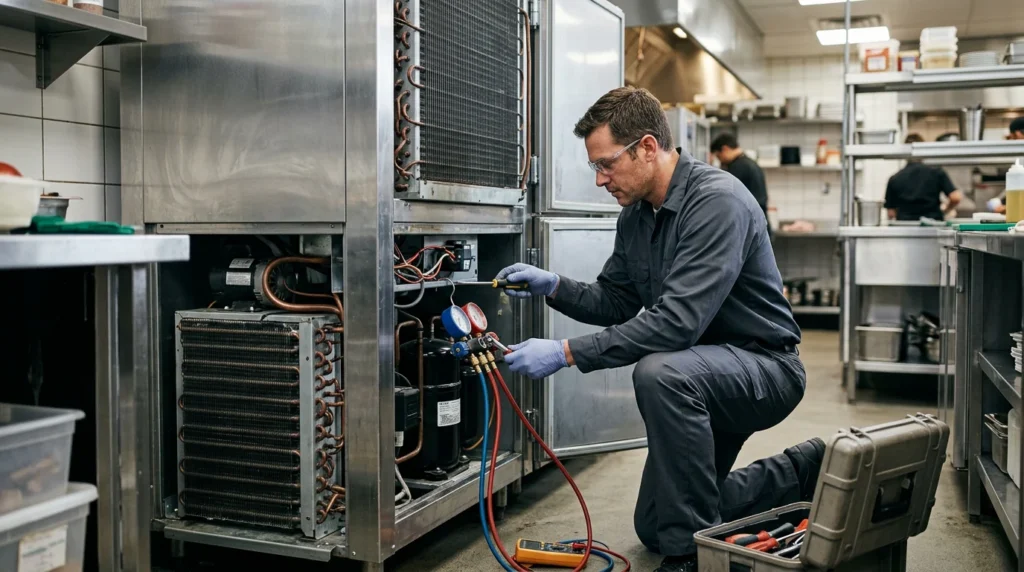
Quick answer: Call a commercial HVAC/R service company that routinely works on walk-ins, reach-ins, ice machines, and rack systems and can respond quickly with the right diagnostic tools and common parts. A good provider will confirm the symptoms, check temperatures and pressures, look for airflow and defrost issues, and verify electrical controls and refrigerant charge. Ask about after-hours availability, food-safety priorities, and leak-repair capability.
What to Look for in a Repair Provider
Commercial refrigeration is a mix of refrigeration mechanics, electrical controls, airflow management, and food-safety urgency. You want a team that can troubleshoot across all of that—not just “top off refrigerant”—and that can explain the root cause in plain language so the problem doesn’t keep coming back.
Use a simple selection checklist. Confirm they service your equipment type (walk-in cooler/freezer, reach-in, prep table, ice machine, remote condensing unit, or rack system), ask about after-hours response, and ask whether they can do leak detection and leak repair (not just add refrigerant). It also helps if they commonly stock failure items like contactors, capacitors, fan motors, defrost components, and sensors, since that can reduce downtime.
If you’re comparing providers online, a page like DuPont commercial refrigeration repair can be a useful prompt for what to ask about (equipment coverage, emergency service, and refrigeration-specific capability). Treat it as a checklist and still confirm availability and scope directly on the phone.
Signs You Need Service Now (Not Later)
Some symptoms call for immediate service because they can lead to rapid temperature rise, product loss, or compressor damage:
- Box temperature rising fast or already out of range
- Compressor short-cycling (starts/stops repeatedly) or running nonstop with little cooling
- Repeated clicking/buzzing at the condensing unit (possible start or electrical issue)
- Breaker/fuse trips, burning smell, or visible arcing
- Evaporator coil packed in ice or no airflow from the evaporator fans
- Oil staining around piping joints or components (can suggest a refrigerant leak)
While you wait, protect product: keep doors closed, move high-risk items to backup cold storage if possible, and document product and box temperatures for food-safety records.
What to Say on the Phone
Giving the dispatcher clear details usually speeds up triage and helps the tech arrive prepared. You can use this quick script:
- Equipment: “We have a walk-in cooler/freezer / reach-in / ice machine (brand/model if known).”
- Current temps: “Box temp is __°F; setpoint is __°F; product temp is about __°F.”
- Alarms/messages: “The controller shows __ / alarm light is on / it’s beeping.”
- What’s running: “Condenser fan is (on/off), evaporator fans are (on/off), compressor is (on/off/short-cycling).”
- Recent changes: “We had a power outage / deep cleaning / heavy loading / door left open / maintenance yesterday.”
- Visible symptoms: “Ice on the coil / water on floor / loud noise / warm air at vents.”
If you can do it safely, also mention whether the condenser coil looks dirty or blocked and whether the unit has clear airflow around it.
What a Solid Diagnostic Visit Typically Covers
A thorough call usually checks the basics first, then narrows down the failure. Many techs will work through steps like these:
- Operating conditions: ambient temperature, door sealing, loading/airflow restrictions, coil cleanliness
- Air movement: condenser and evaporator fan operation, airflow across coils, signs of iced/blocked evaporator
- Electrical: supply voltage, amp draw, contactors/relays, capacitors, safeties and breaker history
- Controls/defrost: thermostat/probe accuracy, defrost timer/board behavior, termination sensor/heater checks
- Refrigeration performance: pressures and line temperatures, evidence of restriction, and charge/leak indicators
Defrost faults are common on freezers: a failed heater, bad termination sensor, stuck relay, or incorrect schedule can ice the coil until airflow collapses. On the hot side, a dirty condenser, failed condenser fan, or blocked ventilation can drive head pressure up and trigger shutdowns.
Ask for a plain-language explanation of what failed, what likely caused it, and what would prevent a repeat call.
How to Reduce Repeat Breakdowns After the Repair
Most repeat issues come from airflow, cleanliness, and door problems. A simple prevention checklist helps:
- Keep condenser coils clean and make sure the unit has breathing room (no boxes blocking airflow)
- Check door gaskets, hinges, and closers so doors seal and self-close
- Keep evaporator airflow clear (don’t stack product tight to the fan/coil area)
- Clear and sanitize drains so they don’t back up and refreeze
- Watch for early ice buildup that suggests a defrost or door-seal issue
- Log box temps and any alarms/noises to speed up future troubleshooting
Next step: call a qualified commercial HVAC/R provider and ask about after-hours coverage, parts availability, and leak-repair capability. If you’re already working with Nextech, the same questions help you set expectations and reduce downtime.